Antwort von Maria 1.0 auf das kfd-Papier zum § 218 StGB
Donnerstag 11.06.2026
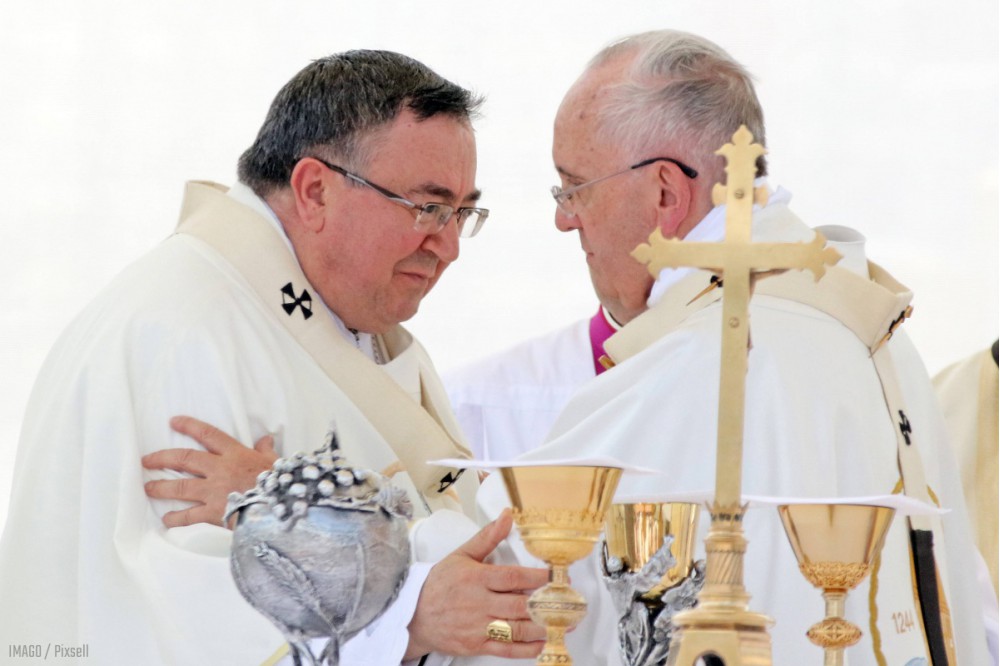
When St. Pope John Paul II received him into the College of Cardinals on November 26, 1994, 49-year-old Vinko Puljić was the youngest cardinal. Today, Vinko Cardinal Puljić is the Archbishop of Vrhbosna (Sarajevo). The Archbishopric of Sarajevo has its origins in the 7th century. It was re-established as an episcopal see in 1881. The archdiocese is located in the east of the country and borders Croatia to the north, Serbia to the east, and Montenegro to the south. The diocese includes parts of the Federation of BiH and the Serbian Republic. In addition to shepherding his diocese, Archbishop Puljić is also a member of the Congregation for the Evangelization of Peoples and the Pontifical Council for Interreligious Dialogue as a cardinal. In December 2020, the now 75-year-old survived a serious COVID-19 illness. Mary 1.0 spoke with Cardinal Puljić. The interview was mediated by Thommy M. Schott and translated by Dinka Mihic. Clara Steinbrecher, head of the Maria 1.0 initiative, conducted the interview.
Maria
1.0: Your Eminence, in December 2020 you had to be hospitalized due
to a Corona infection. How are you doing today?
Cardinal
Puljić: I
am grateful to God that I went to the hospital on time. I encountered
very dedicated doctors and medical staff. Although I survived Corona
well, I am still bearing the consequences. I have admired the medical
staff who have always been patient with all patients despite the
heavy workload. I am not the same as I was before Corona, but I am
grateful to God that I am able to perform my duties on a regular
basis.
Maria
1.0: The Catholic Croats are the smallest of the three state-bearing
ethnic groups in your homeland. How would you describe the situation
of Bosnia and Herzegovina's Catholics a quarter of a century after
the end of the war?
Cardinal
Puljić: While
the Dayton Agreement ended the war, it did not create a just peace.
Dayton divided Bosnia and Herzegovina into two parts. In one part,
the Republika Srpska (Serb Republic, editor's note), ethnic cleansing
has been legalized and there are almost no Catholic Croats there. In
the other part (Federation of Bosnia and Herzegovina, ed.), where
Croats and Bosniaks live, a majority of Bosniaks have emerged over
Croats. People are insecure and frustrated. Even those who endured
the war are now leaving the country. Unfortunately, equal rights have
not been established for all three constituent peoples and the same
rights do not apply in all areas.
Maria
1.0: If you visit the Holy Mass of a Croatian parish in Germany, you
notice that the churches are full and almost all generations are
represented among the faithful. Is the Catholic Church in your
country more vital than it is in Germany, for example?
Cardinal
Puljić: Throughout
history, our Catholics have found support and a source of strength in
the faith. Now, when they leave the land of their ancestors, they
carry with them the faith of their fathers, in which they grew up and
for which they endured a great deal, especially during the communist
era. The oldergeneration
will live this faith, but the younger ones will quickly adapt to the
environment they came to because they go to school there and public
opinion influences their worldview.
Maria
1.0: The Virgin Mary, many say, has shown Bosnia a great grace
through her presence in Međugorje. What does this place of
pilgrimage mean to you personally?
Cardinal
Puljić: Throughout
history, our people have been particularly devout to the Blessed
Virgin Mary. I believe that there is not even one house without a
picture of Our Lady on the wall. We have several places that have
become shrines to Our Lady throughout history. People like to do
penance there and fulfill their vows. Medjugorje is perhaps the
largest confessional in the EU, as many come to pray to Our Lady,
confess and make a personal vow. There they find comfort through
faith and the ability to carry their cross in life.
Maria
1.0: The Catholic Church in Western Europe is in a great crisis. Some
sacraments, such as the Sacrament of Penance, are literally on the
ground. Especially in Germany, the so-called reformers stand opposed
the Catholics faithful to the traditional teaching. As a cardinal of
the universal Church, how do you assess the current
developments?
Cardinal
Puljić: The
risen Christ is the center of our faith. St. Paul called us to
conform ourselves to Christ. Unfortunately, in this secularized
spirit, things have been twisted. We ask Christ to conform to us. We
have a saying: If you do not act as you think, you begin to think as
you act. This is exactly what is happening in the spirit of
relativism and secularism. We remember very well how the communists
demanded that we separate ourselves from the one holy Catholic and
Apostolic Church. Blessed Alojzije Stepinac paid a high price for
this because he remained faithful to the unity of the Church.
Maria
1.0: In Germany, the Synodal Way deals with issues such as the
priesthood for women or the abolition of compulsory celibacy. Are the
Catholics in Sarajevo also concerned about these issues?
Cardinal
Puljić: A
church that has survived the challenge of communism doesn’t have
ideas as exotic as these. In fact, such attitudes offend and astonish
our believers. We cannot understand a church where sacrifice becomes
a foreign word and where there is a Jesus without a cross. There can
be discussions on all subjects, but based on the Gospel and not based
on secularism and relativism. Religious arbitrariness has made itself
comfortable in the life of the church, but we must return to the
original gospel.
Maria
1.0: The dispute between the German local churches and the Vatican
over the formulation of doctrine is seen as a quarrel by the German
public. Many Catholics worry about a schism in the church. You
yourself were the head of a bishops’ conference once. As bishop,
what would you recommend to your German fellow priests?
Cardinal
Puljić: The
only thing I can do is to pray to the Holy Spirit to enlighten
everyone personally and all together, especially those who lead the
Church in Germany. May the divine have primacy of place. I would not
pretend to be a judge, but I cannot accept such views.
Maria
1.0: Will Pope Francis take another personal look at the Church in
Germany one day?
Cardinal Puljić: I can neither foresee nor influence what the Pope will do. If he should ask me for my opinion, I will clearly demonstrate to him the opinion of the suffering church.
Maria
1.0: Your Eminence, you are a member of the Congregation for the
Evangelization of Peoples. Is there a need for a new evangelization
in Europe, or is missions not long overdue, in the face of
encroaching atheism?
Cardinal
Puljić: Due
to my health condition, I no longer participate in congregations. I
have dedicated myself both to this local Church and to the Church in
Bosnia and Herzegovina. At the same time, my term is slowly coming to
an end, and I hope that I will remain faithful to the true faith that
I have lived for over 75 years.
Maria
1.0: The Holy Father has proclaimed a Year of St. Joseph. What does
Saint Joseph mean to you?
Cardinal
Puljić: In
this crisis of families, especially the crisis of fatherhood, the
Year of Saint Joseph is a wonderful incentive for restoring the
dignity of fatherhood within the family and society. In particular,
every parent should prove himself worthy of the trust God gives him
as long as he travels this earth.
Maria
1.0: Thank you for speaking with us.
Cardinal
Puljić:Thank
you for your confidence.