Antwort von Maria 1.0 auf das kfd-Papier zum § 218 StGB
Donnerstag 11.06.2026
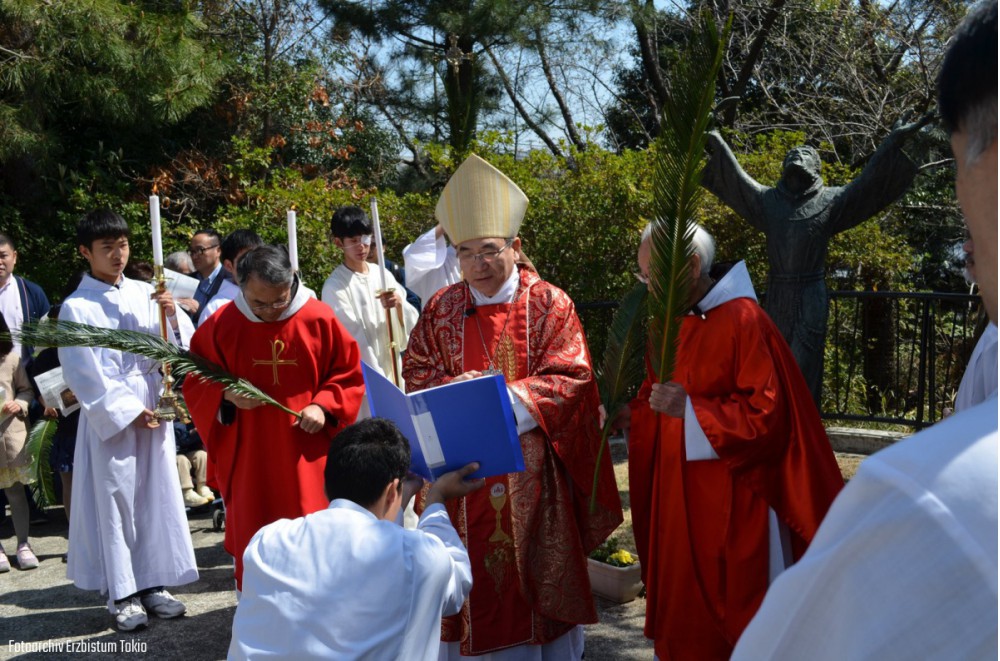
The Archdiocese of Tokyo, the largest Japanese diocese, has maintained a diocesan partnership with the Archdiocese of Cologne since 1954 (https://www.erzbistum-koeln.de/kirche_vor_ort/weltkirche/gebets_und_hilfsgemeinschaft_tokyo-koeln/). It is remarkable that this diocesan partnership was established at a time when both countries were still suffering the consequences of the Second World War. In particular, substantial financial support from Cologne helped rebuild the church in Tokyo after the war. This partnership was extended to the church in Myanmar, which both archdioceses now support jointly. The partnership between Cologne and Tokyo served as a model for numerous diocesan partnerships around the world. The Tokyo Archdiocese has been led by Archbishop Tarcisius Isao Kikuchi SVD, [ SVD = Societas Verbi Divini = Society of the Divine Word = Steyl Missionaries] since 2017; he also president of Caritas in Japan and Caritas Asia. He also spent eight years as a missionary in Ghana and has been a member of the Congregation for the Evangelization of Peoples since 2014. The written interview questions were asked by Clara Steinbrecher, director of the Maria 1.0 initiative, and Riyako Cecilia Hikota, a member of the Archdiocese of Tokyo, who also translated the answers from Japanese.
Maria 1.0: Your Excellency, dear Archbishop Tarcisius Isao Kikuchi SVD,
we are grateful that you have taken your precious time to answer our questions.
We have heard that although the Corona situation in Japan was not as serious as in Europe in terms of the number of people infected, hospitals were overloaded, and the vaccination process was delayed. How did the Catholic Church in Japan respond to the Corona situation? Looking back on the measures taken, is there anything you would like to share with us in this regard?
Archbishop Kikuchi:Towards the end of January 2020, I heard from a missionary who worked in Hong Kong and whom I knew personally that the Archdiocese of Hong Kong was considering measures in view of the spread of an unknown epidemic. So, following the example of Hong Kong, I began to consider, in consultation with our lay medical members, what measures should be taken in the Archdiocese of Tokyo. First, I called for infection prevention and control at the end of January 2020, and from February 27, we cancelled all public masses. The other archdioceses in Japan then took the same measures, and we had no public Masses until June 2020. After that, our bishops' conference established guidelines, and since then we have responded flexibly to circumstances. Basically, we have continued to celebrate Masses with extensive infection prevention measures while limiting the number of visitors. We have also broadcast Mass live on the Internet for those who cannot come to church in person. Since Christians are a minority in Japan, I didn't want any church to become a source of infection. And since churches in Japan have a high percentage of elderly members, I wanted to protect their lives as well. That is why I insisted on taking extensive infection prevention measures. Even today, some of our lay members criticize our strict measures, but I believe that these measures were necessary for us to fulfill our social responsibility. I will continue to make responsible decisions while listening to the advice of medical experts and assessing circumstances to protect the lives of others.
Maria 1.0: The Christian population of Japan is about 1% (the Catholic population is about 0.5%). How would you describe the current situation of the Catholic Church in Japan, in terms of the evangelization process or the composition of the membership? Can you tell us something about it?
Archbishop Kikuchi:The percentage of the Christian population in Japan has not changed, and I think the same is true of the general religious composition in Japan over the last 50 years. Few people in Japan are interested in organized religion, but still, many of them have religious interest, and traditional Japanese culture is also religious. Japanese society as a whole is facing an aging population and a declining birth rate, and this is also true for our church. Everywhere, church activities are supported by older members. We used to have many social institutions and schools run by the Catholic Church, but gradually there are fewer and fewer of them. Evangelization is a great challenge in Japan, but at the same time it opens up many opportunities to face it with confidence.
Maria 1.0: There are some Japanese Catholic communities in Europe (Paris, Vienna, Düsseldorf and Cologne). Are you aware of the activities of Japanese Catholics abroad? If so, could you comment on the differences or similarities in characteristics between Japanese Catholics abroad and Catholics living in Japan?
Archbishop Kikuchi:I am not informed in detail about the activities of all Japanese Catholic communities abroad, but I have connections with some of them. These parishes abroad are often located in societies more influenced by Christianity than Japan, which, in my opinion, helps them to protect traditional forms of faith. Also, what these Japanese congregations abroad have in common with the Church in Japan is that they are a minority in the society in which they live. I believe that our bishops' conference should also take responsibility for the Japanese Catholic communities abroad.
Maria 1.0: Our Lady has a special place in the Catholic faith in Japan as well. Even in the early days of the mission to Japan, St. Francis Xavier entrusted the whole country to the protection and devotion of Our Lady - this was especially significant for the Japanese underground Church. Could you tell us something about the importance of Marian devotion in Japanese Christian history?
Archbishop Kikuchi:There is a well-known anecdote: after a long period of persecution, French missionaries resumed missionary work and built the Oura Cathedral in Nagasaki. Then the Japanese Christians who were hiding came to the cathedral and asked, “Where is the statue of the Virgin Mary?”
We also have many statues of Our Lady disguised as Buddhist statues that date back to the time of persecution. Our Lady is of great importance to Japanese Catholics as the mother of us all; she concretely shows the importance of mercy in Christianity. But unfortunately, the importance of Our Lady is being forgotten as modern values continue to spread.
Maria 1.0: It is also known among Catholics in the world that Our Lady appeared in Akita. What significance does this place of pilgrimage have for you personally?
Archbishop Kikuchi:Before becoming Archbishop of Tokyo, I was Bishop of the Diocese of Niigata, where Akita is located, from 2004 to 2017. So, Our Lady of Akita means a lot to me personally. The miracle of the statue of Our Lady shedding tears was confirmed by Bishop Ito of Niigata at that time, and many pilgrims from all over the world visit Akita. I think Akita will remain a particularly holy place of prayer in Japan in the future.
Maria 1.0: The Catholic Church in Western Europe is in a great crisis. Some sacraments, such as the Sacrament of Penance, are literally on the ground. Especially in Germany, the so-called progressive Catholics stand opposed the Catholics faithful to the traditional teaching. As a leading member of the universal Church, how do you assess the current developments in Western Europe?
Archbishop Kikuchi:I think that in a society based on Christianity, it is only natural that when social values change, this Christian foundation is also called into question. Therefore, the problem of secularization in Germany is rather proof that Christianity is deeply rooted in the cultural foundation. In this sense, such a conflict between tradition and progress is nothing surprising, but a natural consequence. Instead of taking an either-tradition-or-progress view, it is necessary to re-evaluate the Christian foundation of culture from a modern perspective.
Maria 1.0: The Archdiocese of Tokyo has had a diocesan partnership with the Archdiocese of Cologne for almost 70 years. How well known, would you say, is this fact among Japanese Catholics?
Archbishop Kikuchi:I don't think all Japanese Catholics know it, but at least the members of the Tokyo Archdiocese are still grateful to the Archdiocese of Cologne. This is because not only the Tokyo Cathedral but also several other churches have been built with support from Cologne. In partnership with Cologne, we are currently supporting the church in Myanmar, and the members of the Archdiocese of Tokyo know that, too.
Maria 1.0: Apropos Cologne: This largest Catholic diocese in Germany has faced the scandal surrounding sexual abuse in recent years. Do you follow the news about it? How would you rate the German, but also the international reporting on this matter? How does the local church react to this matter?
Archbishop Kikuchi:I only know as much as I learn from the news media in general, but I think it is necessary for the future of the Church to honestly face the mistakes that were made in the past. Cases of sexual abuse of minors by Catholic clergy have also come to light in Japan, although in small numbers. However, there have also been some cases of sexual molestation against adults. Our bishops' conference has guidelines for this, and each diocese has an emergency phone and a committee to deal with these problems. In addition, there are not many experts in this field because people are not yet used to dealing with these problems, not only in the Church but also in Japanese society as a whole.
Maria 1.0: In Germany, the Synodal Way deals with issues such as the priesthood for women or the abolition of compulsory celibacy. Are these questions also of interest to Catholics in Japan?
Archbishop Kikuchi:I think they are interested in the Synodal Way itself. At the end of last year, I formulated the guidelines for evangelization and pastoral care in the Archdiocese of Tokyo. For this, I had taken more than a year to gather the voices of the members of our archdiocese. The method of bringing all voices into the discourse is endorsed by all participants (synodality). However, in this process [of drafting the guidelines], I personally did not hear any voice calling for the priesthood of women or the abolition of mandatory celibacy for priests. I know that a few are calling for these things, but I don't think they represent the majority at this time. However, considering that we have a low number of vocations to the priesthood, we will face a shortage of priests in the near future. Then, I think, we may have to pay more attention to those voices as well.
Maria 1.0: The dispute between the German local churches and the Vatican over the formulation of doctrine is seen as a quarrel by the German public. Many Catholics worry about a schism in the church. What would you recommend to German Catholics?
Archbishop Kikuchi:This conflict with the Vatican will not divide the church. Not only the church in Japan, but also many churches in the so-called mission fields have often had conflicts with the Vatican over cultural issues, but this will not divide the church. Disagreements can produce even greater fruit through proper dialogues. We don't have to be afraid of disagreements. I think the most important thing is that you do not turn your backs on each other, but continue your dialogue face to face. Then a dialogue can surely bear rich fruit.
Maria 1.0: You also worked in Ghana for a few years. Based on your knowledge of the Catholic Church in Ghana and Japan, how would you assess the current situation of the Church in Western Europe as well as that of the universal Church?
Archbishop Kikuchi:I worked in a church in Ghana for eight years. I was the pastor of a church high in the mountains. I pastored a church high in the mountains. Ghana was still a poor country then, but I think there were great expectations of the church, both spiritually and socially. They came together on Sundays, praying and dancing at the same time. There was something powerful about their faith. The genuine expression of the faith of Ghanaian Catholics was the starting point for my priestly life, and I will forever admire these Catholics.
Whether in Ghana or in Japan, the greatest challenge is that everything related to the spiritual life must be translated (from external sources). Our faith itself remains something “translated,” and it is difficult to root our faith in our own culture. In this sense, I find it sad to see that the Christian faith is declining in Europe, when it is actually so firmly rooted in its own culture. Certainly, the teaching of the Church has an inner core that must be protected, but at the same time the Church must try to present its attitudes in a way that responds to the needs of the times. If the Church communicates this unchanging teaching, while at the same time being careful to make it speakable to the society at hand, then the Church can continue to maintain a relevance to society.
Maria 1.0: Pope Francis visited Japan in November 2019. Has this papal visit had any impact on the local church? If so, could you elaborate?
Archbishop Kikuchi:Unfortunately, few Japanese knew about the global influence of the papacy. Therefore, quite a few Japanese were not aware that Pope Francis' statements were actually addressed to the whole world, so that they misunderstood, for example, his appeals for nuclear disarmament and for the reception of refugees as criticism of Japanese society. Nevertheless, many people were touched by Pope Francis' messages for young people and for the victims of the Tohoku earthquake and tsunami, both in 2011. I also believe that the messages he gave in Hiroshima and Nagasaki had a great impact on political leaders and those involved in peace-building activities. I wanted to continue building on the basis of Pope Francis' messages when the memory of his visit was still fresh, but then the Corona Crisis came. So, unfortunately, I could not do anything yet.
Maria 1.0: The Holy Father has proclaimed a Year of St. Joseph. What does St. Joseph mean to you personally?
Archbishop Kikuchi:Someone as humble as St. Joseph is exactly what we need to make the Gospel a reality in this world. We tend to want to be in front of everyone and seek attention, but the most important person is one who works behind the scenes, although no one may notice him. The whole society needs such humility, but we need it especially in evangelization.
Maria 1.0: Thank you very much for taking the time to answer our questions!