Antwort von Maria 1.0 auf das kfd-Papier zum § 218 StGB
Donnerstag 11.06.2026
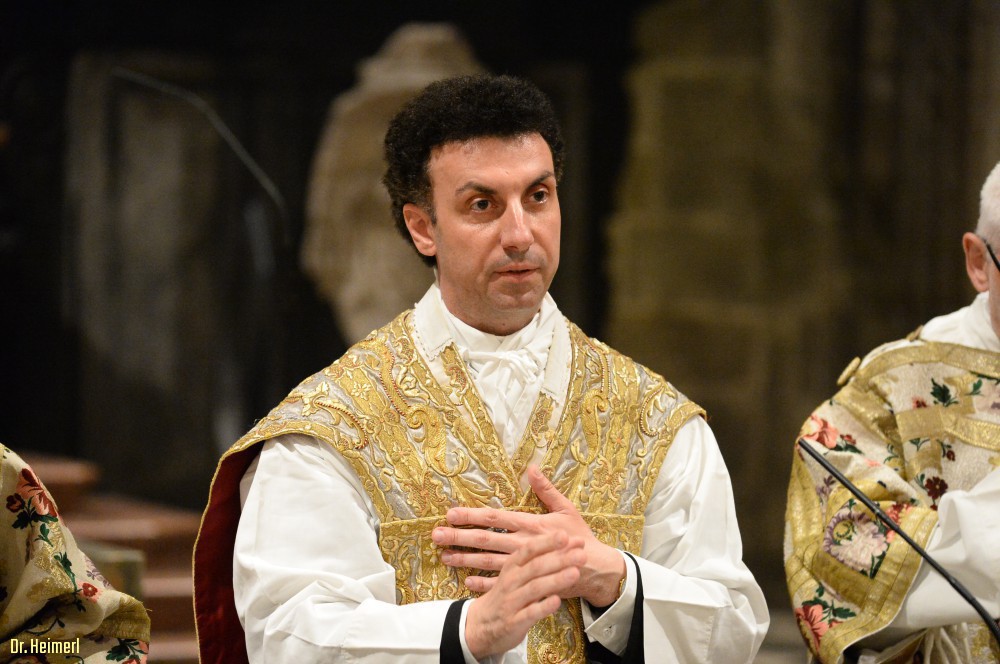
Maria 1.0: Dear Dr. Heimerl, thank you very much for taking the time for this interview. You recently signed the Reform Manifesto (see below for explanation). Could you perhaps first explain to our readers who you are and what you do?
Dr. Heimerl: I come from an old Viennese family on my father's side, am a priest of the Archdiocese of Vienna, and pastoral assistance at St. Stephen's Cathedral. In addition, I teach at a high school and help out as a priest in Bavaria, where I grew up. A special concern of mine is the pastoral care of the sick. Even when I am ill, it has become a “vocation within a vocation” for me.
Maria 1.0: What motivated you to sign the Reform Manifest?
Dr. Heimerl: First of all, I would like to sincerely thank the initiators of the manifesto for their commitment! I myself, by the way, do not share the view that the Church needs profound or revolutionary reforms. What it always needs, on the other hand, is renewal in the Holy Spirit, which is given to it again and again by God Himself, and it must above all fulfill the mission of evangelization. - I understand the manifesto as a countermovement to the so-called “Synodal Way”. This is what I have been waiting for and praying for - as have many others. Signing the Manifesto is a matter of course for a faithful Catholic, even more so for a priest, or at least it should be. We are all called to bear witness to our faith, to preserve the faith, and to defend it. This is what the martyrs did with their blood, and they are still doing it today in many parts of the world - hardly noticed by us. In this respect, it is a comparatively small act of witness to sign a statement for Christ and the Church. I would like to say this quite clearly in this context: Even if the Synodal Way gives itself the appearance of being ecclesial, it is itself outside the Church and in opposition to the Church. Cardinals Kasper and Müller have already stated this very clearly, as has Bishop Voderholzer. Conversely, the signature [to the Manifesto] expresses exactly that: We stand by the Church and the Pope - and not by the theologically aberrant constructs that the Synodal Way designs.
Maria 1.0: The nine theses of the Reform Manifesto stand in contrast to what is currently being talked about on the so-called “Synodal Way”. What is your assessment of the latest developments at the Synodal Assembly?
Dr. Heimerl: The so-called “Synodal Assembly” has departed from the teaching of the Church and from the Church itself from the very beginning. Just read the texts and you will hardly find anything that is not contrary to the teaching of the Church. The fact that the letter of the Holy Father to the Church in Germany was completely ignored (and the opposite was claimed) is just as outrageous as the claim that you continue to be “Catholic” while you go around arrogantly and self-righteously questioning the sacraments, the Church as the universal sacrament of salvation, the authority of the popes, and that of the councils. Ultimately, it tries to invent a new church out of its own “authority” – I would like to say: a church without God. Significantly, there is hardly any talk about Jesus Christ, but only about how to bring the faith to the “people” and how to adapt it to the people of today. Obviously, the Gospel does not come to anyone's mind here when Jesus says to Peter: “Away with you, Satan, for you do not want what God wants, but what men want.” (Mt. 16:23) - With this, basically everything is said on the subject of “adapting the faith to the spirit of the times” and this verdict of Christ applies to the entire Synodal Way.
The fact that quite a few bishops are obviously involved in this gives the whole thing a comparatively new and also shocking dimension. As it is, the task of the bishops would be the exact opposite: to proclaim the faith (as it is) and also to confess it bravely. Every bishop and every priest has taken an oath on the Gospels before his ordination to do this. I find the behavior of many German bishops shameful. All the more praiseworthy are the exceptions; I would like to explicitly mention Bishop Voderholzer and Bishop Oster, for example, who are not afraid to take a clear position.
Maria 1.0: What can other Catholics do, especially lay people, who cannot identify with the “reform concerns” of the Synodal Way?
Dr. Heimerl: Of course, we must first and foremost ask Christ as the Lord of the Church to assist the Church in Germany. The Church is, after all, Christ Himself, and for that reason alone it is unchanging. In this respect, we may trust in the help of God, who is always at work in His Church. On the other hand, of course, one must also become active in some way - and this could include, for example, support for the manifesto or a clear confrontation locally. We must not leave the field to the “synodals” in the parishes, no matter how vociferous, demanding and unpleasant they appear (see below).
Maria 1.0: It can be observed that many people feel connected to the concerns of the reform manifesto, but shy away from signing it in order to avoid possible negative consequences by their own bishop or a bad atmosphere within their parish or at their workplace. How do you perceive this, and what would you like to see happen to improve the culture of discussion?
Dr. Heimerl: It is frightening when the so-called “synodals” promote an open culture of discussion and then fail to adhere to it themselves. I myself have experienced, for example, that women started to cry out during my sermon just because I pointed out in an aside that only men can become priests and that this is the unchanging belief of the Church. But I think that the more the followers of the Synodal Way decuvre themselves in this way, [decuvre = expose] the better it is. These are just the fruits by which one recognizes their spirit. - I would like to encourage everyone to faithfully confess Christ and the Church. Of course, this costs something, but it cannot be otherwise in the following of Christ on the way of the cross. Lately, I have often thought of Blessed Father Rupert Mayer. His motto was: “I am not silent.” For the sake of Christ, let us adhere to this and be his witnesses.
The Reform Manifesto was published on September 29, 2021, on www.neueranfang.online/manifest. It was written by the “Arbeitskreis Christliche Anthropologie” - a Christian interest group that is engaged in anthropology, ethics, philosophy, theology, and journalism. The Reform Manifesto consists of 9 theses: 1. Legitimation, 2. reform concept, 3. unity with the whole universal church, 4. power, 5. women, 6. marriage, 7. blessing of same-sex unions, 8. laity and priests, 9. abuse.
In it, the authors of the manifesto deliver a damning indictment of the German Synodal Way: It “misses the beginnings of true reform dramatically.” [The manifesto states that] in its fixation on external structure, it “passes by the heart of the crisis.” [The manifesto furthermore states that] it violates peace in the congregations, abandons the path of unity with the universal Church, damages the Church in the substance of its faith, and amounts to a schism (= the founding of a separate Church detached from Rome). The reform manifesto can be signed here:https://neueranfang.online/manifest/#unterzeichnen
The head of Maria 1.0, Clara Steinbrecher, as well as many supporters have already signed the Reform Manifesto.