Antwort von Maria 1.0 auf das kfd-Papier zum § 218 StGB
Donnerstag 11.06.2026
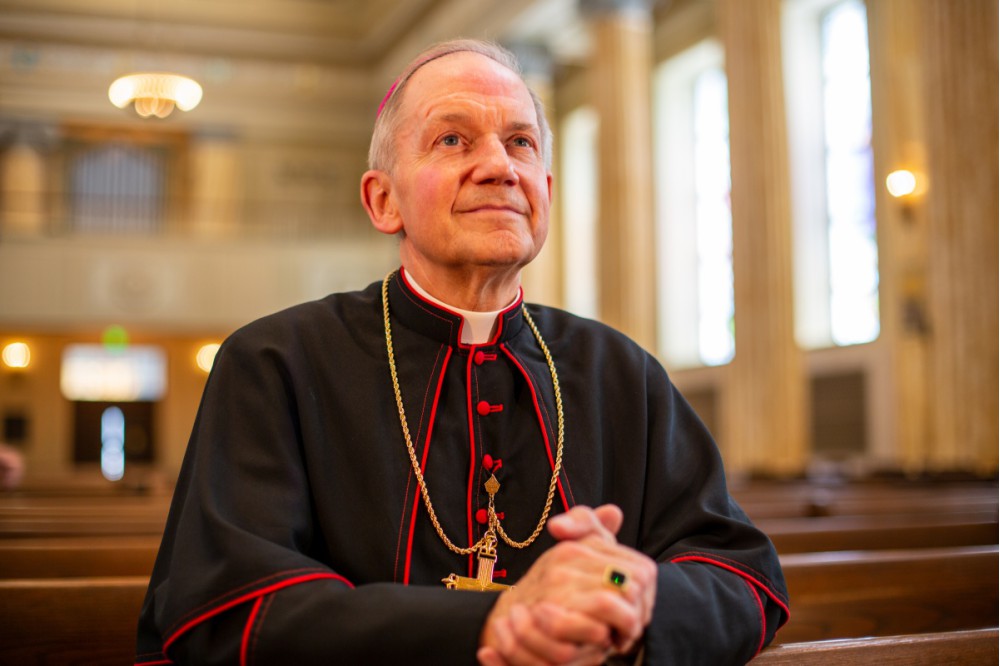
Thomas John Paprocki was ordained a priest in 1978 and appointed auxiliary bishop of Chicago by Pope John Paul II in 2003. Since 2010, he has been Bishop of the Diocese of Springfield in the State of Illinois in the United States of America.
Maria 1.0: Before the pandemic, you participated in numerous marathons. Have sports always played a significant role in your life; how did it influence your faith?
Bishop Paprocki: Yes, I come from a big family. I’m the third oldest of nine children. I have six brothers and two sisters, so I always had playmates and sports were one of our favorite hobbies. I started running races while in high school after I realized that three of my grandparents had died of heart disease in their fifties. I had read about the positive effects of aerobic exercise such as running, biking, and swimming on the cardiovascular system. So, I decided to make running a hobby. After running rather shorter distances for years, I started running marathons in 1995. From 1995 to 2018, I participated in 24 marathons. In addition, I competed in half marathons in 2019 and 2020. I really hope to participate in a few more marathons at some point: The plan is for me to be at the marathon in Indianapolis on November 6 this year. Sports have impacted my faith by helping me value the connection between body and soul. A strong faith motivates and inspires us to do things like run a marathon to stay healthy and raise funds for charity. For more detail on this, see my booksHoly Goals for Body and Soul andRunning for a Higher Purpose (for more information on Bishop Paprocki's books, see also www.holygoalie.net).
Maria 1.0: Recently, you made headlines when you barred politicians who openly support abortion from receiving Holy Communion. Not everyone agreed with this decision, and you have faced some headwind. Can you explain why you made this important decision?
Bishop Paprocki: We read in the Bible in the 1st letter of the Apostle Paul to the Corinthians (11:27): “Whoever, therefore, eats of the bread and drinks of the cup of the Lord in an unworthy manner is guilty of the body and blood of the Lord.” Furthermore, the Code of Canon Law of the Catholic Church states that those “obstinately persevering in manifest grave sin are not to be admitted to holy communion” and whoever “is conscious of grave sin is not to celebrate Mass or receive the body of the Lord without previous sacramental confession” (Can. 915-916). This is not to be seen in the sense of passing judgment on the state of a person's soul, which is God's alone. Rather, it refers to a person's visible actions in relation to objective, serious sins. Politicians who persistently, continuously, and unequivocally advocate the grave sin of abortion cannot be admitted to receive Holy Communion. In June 2019, in accordance with Canon 915 of the Code of Canon Law of the Catholic Church, I issued a decree declaring that Illinois Senate President John Cullerton and Illinois House of Representatives Speaker Michael J. Madigan, who facilitated the passage of the Abortion Act of 2017 (House Bill 40) and the Reproductive Health Act of 2019 (Senate Bill 25), are ineligible to receive Holy Communion in the Diocese of Springfield, Ill, because they have persistently and continuously promoted the heinous crime and most grievous sin of abortion, as evidenced by the influence they have exercised over a long period of time in their leadership roles, in their repeated voting record, and in their unyielding public support for abortion rights.
Maria 1.0: SinceTraditionis Custodes was published, there has been much discussion about the “Traditional Latin Mass” (TLM). In your diocese, the TLM will continue as before. We are interested in knowing what the TLM means to you personally.
Bishop Paprocki: In my home parish in Chicago, I served as an altar server before the Second Vatican Council, and accordingly I learned my prayers in Latin and participated in the Holy Sacrifice of the Mass in the Tridentine form, or, as you say, in the context of the Traditional Latin Mass (TLM). Since attending a preparatory seminary in 1966, all of my formation has been guided by the missal revised by Pope Paul VI, which is sometimes referred to as the Novus Ordo Mass or, in Pope Benedict XVI's terminology, the Mass in the Ordinary Form. When I was Chancellor of the Archdiocese of Chicago, I said a Novus Ordo Mass in Latin once a month at St. John Cantius Church. I did not celebrate the Traditional Latin Mass until 2010 as Bishop of Springfield in Illinois. As diocesan bishop, I have occasionally celebrated the TLM at St. Rose of Lima Church in Quincy and at Sacred Heart Church in Springfield, where the TLM is regularly offered by the Priestly Fraternity of St. Peter and the St. John Cantius Regular Canons, respectively. Personally, I am more comfortable celebrating the Novus Ordo Mass, having become accustomed to this form of Mass over the years. In my experience, Novus Ordo Masses can be celebrated with great reverence in the Latin language, evenad orientem, with Gregorian chants and incense. At the same time, I have a pastoral care for those who prefer to pray Holy Mass in Latin according to the 1962 Roman Missal, so I have given permission for these Masses to continue in the churches mentioned.
Maria 1.0: Are there other issues that move people in the United States of America, especially Catholics? Or are there things worth knowing about the Catholic Church in the USA that you would like to tell Catholics in Germany?
Bishop Paprocki: Many Christians in the United States of America, especially Catholics and non-Catholic evangelical Christians, express great concern about the increase in abortions on demand since the Supreme Court's Roe v. Wade landmark decision in 1973. Catholics in particular are outraged when politicians who claim to be Catholic endorse the grave sin of abortion. It would be improper, without foundation, and inconsistent with our faith for these same politicians to receive Holy Communion as supporters of abortion unless they show remorse and experience a change of heart.
Maria 1.0: We know that there are people in the U.S. and around the world who are looking with concern at Germany and processes like the Synodical Way. What are your thoughts on this? Are you concerned that there might be a split?
Bishop Paprocki: There are grave concerns about the situation in the Catholic Church in Germany, where priests and bishops have publicly opposed the ban on blessing homosexual relationships, despite the recent warning by the Vatican's Congregation for the Doctrine of the Faith, published with the approval of Pope Francis, which stated that it “is not permissible (to) confer a blessing on relationships or even stable partnerships that involve sexual practice outside of marriage (that is, outside of an indissoluble union of a man and a woman that is in itself open to the transmission of life), as is the case with unions between persons of the same sex.” The German Catholic bishops have also announced a Synodal Way to consider certain issues of interest to the Church in Germany. Judging from what I have read about the Synodal Way, the authoritative idea seems to be that the Catholic Church must adopt the structures and processes of secular liberal democracy. All leadership positions in the Church, including those of bishops and pastors (= parish priests), are to be elective and temporary. Decisions of bishops and pastors can be overruled by a majority. The pope's role in the selection of bishops is merely to confirm the election results of those who elected them. The Archbishop of Denver, Samuel Aquila, has written an excellent and wonderfully articulate theological critique of the basic text of the Synodal Assembly. It is worth reading the whole text, but this sentence summarizes the concerns particularly well: “A careful reading of the basic text in its entirety makes it difficult to avoid the conclusion that the Synodal Assembly hopes to bring about a Church which, far from suffering the contempt of the world for its fidelity to Christ, is primarily influenced by the world and comfortably accepted by it as one recognized institution among others.” Archbishop Aquila calls attention to a statement in the basic text that “there (is) not the one central perspective, not the one truth of the world's religious, moral, and political probation, and not the one form of thought that can lay claim to ultimate authority” and describes it as a “disturbing commitment to an explicit, radical relativism of doctrine” and as “a remarkable assertion, if only for its incomprehensibility.” I agree one hundred percent with Archbishop Aquila on this point.
Maria 1.0: In Germany, there are believers who believe that women have to be admitted to the priesthood, celibacy has to be abolished, and the Church's sexual teachings have to be changed if the Catholic Church is to retain its place in society. What would you like to say to these believers?
Bishop Paprocki: Experience has shown that the mainstream Protestant denominations in Western Europe and North America, which went the way of diluting Christian traditions and embracing a liberal, secular outlook, especially in the area of sexual morality, saw a steep decline in church attendance. The Catholic Church should avoid going down this self-destructive path. The Church will remain strong and indeed grow if it remains faithful to the truths handed down by Christ through the apostles and their successors for two thousand years.
Maria 1.0: Are these issues (women's priesthood, celibacy, sexual morality of the church) also discussed widely in the U.S.?
Bishop Paprocki: Women's ordination, voluntary celibacy, and revolutionary changes in sexual morality are being called for by some extremists in the U.S., but most faithful Catholics want the Church to remain faithful to the teachings of Jesus Christ as found in the Bible and taught by the Catholic Church for two thousand years.
Maria 1.0: What do you think is the most important thing that the Church as a whole should do or teach in our postmodern world?
Bishop Paprocki: The most important thing that the Church must do and teach is the same message that Jesus proclaimed when he began his public ministry: “Repent and believe in the Gospel” (Mark 1:15; cf. also Matthew 4:17).
Maria 1.0: For Pope Francis, the new evangelization is an important topic. In your opinion, how can a new evangelization be successful in Germany and worldwide?
Bishop Paprocki: New evangelization can be as successful in Germany and worldwide as it was for early Christianity: by fulfilling the Great Commission that Jesus gave his disciples at the conclusion of his ministry on earth. “Go therefore and make disciples of all nations, baptizing them in the name of the Father and of the Son and of the Holy Spirit, teaching them to observe all that I have commanded you” (Matthew 28:19-20).
Maria 1.0: Pope Francis has proclaimed this year the Year of St. Joseph. What can we learn from this saint and what should every Catholic know about St. Joseph?
Bishop Paprocki: St. Joseph teaches us through his quiet, exemplary following of God's commandments and through his zealous service to the Holy Family without drawing attention to himself. We can also learn much from St. Joseph by meditating on the various titles given to him in the Litany of St. Joseph, including the seven new invocations added by Pope Francis in May 2021 on the occasion of the Year of St. Joseph.
Maria 1.0: Thank you very much for the interview!