Antwort von Maria 1.0 auf das kfd-Papier zum § 218 StGB
Donnerstag 11.06.2026
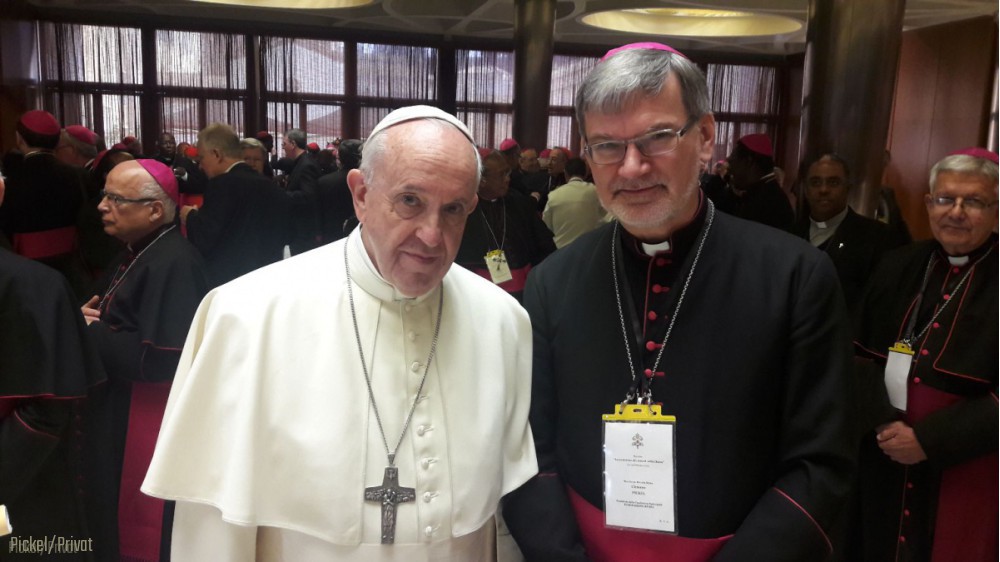
Clemens Pickel is bishop of the Diocese of St. Clement in Saratov, which was erected by Pope John Paul II in 2002 and placed under the Archdiocese of Moscow as a suffragan diocese. He is also president of the Russian Bishops' Conference. Russia comprises four dioceses: the Archdiocese of Moscow, then the dioceses of Saratov, Irkutsk, and Novosibirsk. Bishop Pickel is also president of the Diocesan Caritas of Southern Russia and is intensively involved in humanitarian projects. For this reason, there has been a partnership between Caritas of the Diocese of Osnabrück and Diocesan Caritas of Southern Russia for over thirty years. Among other things, he initiated the project “A Cow for Marx” during his work as a priest in the Volga town of Marx. Bishop Pickel was born in Colditz in the district of Leipzig and was ordained priest by Joachim Reinelt on June 25, 1988. He has worked in Russia since 1990 and was a member of the Pontifical Council Cor Unum, which was dissolved in 2017.
Maria 1.0: As a native German, you have now been working in Russia for over thirty years. What is your impression of the Catholic Church in Germany?
Bishop Pickel: I was born into the Catholic Church in Germany 60 years ago. To my parents and grandparents, as well as to pastors and many others, I am grateful for this home. I am also grateful for the continued support of German relief organizations and individuals, without which many things would not be possible in our extreme diaspora situation. However, it is sad to look at the closed seminaries and novitiates. After all, spiritual vocations are called a sign of the health of the local church.
Maria 1.0: Your Excellency, you were recently in Germany. What is this all about?
Bishop Pickel: It was high time to travel outside [of Russia] once again. We need living contact with the universal Church. Friends helped me to put together a rich program for the eight days of my stay in the “old home country,” which began at the Caritas Association in Osnabrück and ended with the diocesan jubilee in Dresden.
Maria 1.0: The Catholic Church in Germany is currently organizing the Synodal Way. It calls for the priesthood of women, the relaxation or abolition of celibacy, and much more. What do you think of the Synodal Way? How does the Catholic Church in Russia evaluate it?
Bishop Pickel: We are certainly not positioning ourselves as know-it-alls in Russia. The Church, not only in Germany, is going through hard times. No Catholic Christian should be indifferent to that. The public media and social networks have negative, but unfortunately strong influence on the search for solutions. Opinions get dictated. As one who grew up in the former GDR, it frightens me how media-compliant people can be made in a free country. I do not believe that the four major themes of the Synodal Way can lead our church out of the crisis. After all, it's not about keeping an employer, a nice traditional club or a forum with (dis)talk alive. This probably sounds out of touch, but I'll risk saying it anyway: As in every church crisis of the last 2000 years, there is a need for new saints, lovers who can pray and do it gladly.
Maria 1.0: The dispute between the German local churches and the Vatican over the formulation of doctrine is sometimes vehement in the German public. Some Catholics are even worried about a schism in the church. As a bishop, what would you recommend to your German fellow priests?
Bishop Pickel: I would like to see in the “vehemently carried out dispute” a storm in a teacup coming from the north. After all, the universal church is much larger. Nevertheless, what comes over to us via the media sometimes makes us worried. (Whether it is true to the facts is seldom clearer than it seems.) I am sorry, for example, about the way people have been trying to manipulate Christians lately with quotes from so-called “theologians”. I cannot speak meaningfully about God unless I speak to Him. That also remains the fundamental thing for us (German) bishops: the very personal friendship with the Lord. Church schism? I am more worried about the silent desertion in the recent decades, the empty churches, which are only a picture for another emptiness. By the way, it is important for Rome to know the perspectives of the local Churches.Ad limina visits are not just reports on areas of accountability. We pray together: “Come Holy Spirit!”
Maria 1.0: There is supposed to be a worldwide synodal process. What is your opinion on this?
Bishop Pickel: Synods are part of the church. And synods are preceded by processes or means. It is interesting that Pope Francis wants to begin the coming Synod, whose theme will be Synodality of the Church, on October 17 worldwide with a process that already belongs explicitly to the Synod. May it become the answer of the Holy Spirit, whom we ask so often: “... Bend the stubborn heart and will; guide the steps that go astray.”
Maria 1.0: Which current challenges does the Catholic Church in Russia face?
Bishop Pickel: The real challenges do not necessarily correspond to the expectations expressed by various parties. That is the case everywhere. Without a pessimistic undertone, I personally consider it the great challenge for our small Catholic Church in Russia to learn to remain Church with the baptized members, even if in the future they will have to manage without their own priest within a radius of hundreds of kilometers. To lead/accompany someone to a personal encounter with Christ - I consider this to be the vocation of those who labor in this field. In addition, we have the challenges in the social field, to which we try to respond with “Caritas” (in the Christian sense: Caritas, that is all of us). Dialogue with the Russian Orthodox Church is a challenge that is not always easy. If we look closely, the word “love” fits every challenge. I am grateful for my priests and religious from 26 countries of the world because we are united in this.
Maria 1.0: Catholics are a religious minority in Russia. How does that make itself felt? What is the relationship with the Orthodox? What effects of the aggressive communism of the past decades are still felt today?
Bishop Pickel: “We are brothers,” Pope Francis and Patriarch Cyril confirmed in Havana on February 12, 2016, after a historic meeting. Now no one can go back after that. In fact, the relationship between our two churches - and I mean especially within Russia - has become better and clearer. In the background there is still the idea of the so-called “canonical territory”. At the same time, however, the great challenges facing the world as a whole are bringing us together more and more. Critics, of course, sense a lack of spiritual foundation to the relationships here. I ask them for one comment less and one prayer more. We are working on the foundation. The effects of 70 years of church persecution, which ended over 30 years ago, continue to be painfully felt. In the West, one automatically slips into a certain pigeonhole when reminded of tradition in the Church. Here in the East, we experience what it means when someone without tradition tries to be church, without roots. That is indescribably difficult.
Maria 1.0: Since the collapse of the Soviet Union, the Catholic Church has had to rebuild many things from scratch. How important is evangelization or new evangelization in Russia? Are there saints who you turn to especially for intercession? Several people from Soviet times have been canonized meanwhile. Who was Father Ladislaus Bukowinski, who is called the Apostle of Kazakhstan?
Bishop Pickel: When I hear the words “new evangelization,” the voice of St. John Paul II rings in my ears. It is a voice that evokes vivid memories, gratitude and awe. Nevertheless, I have a hard time with the word, probably because of my own limitations. It sounds too technical to me. Was I, too, evangelized at some point? I was educated, accompanied, guided, made curious, encouraged, comforted, enthused.... Somehow it all seems to be taken up in the word evangelization. It is not about the school hours of dry, unsuccessful religious education that, in the best case, leads to disinterested indifference, is it? In short, if evangelization means helping people believe, that is what we do as pastors in Russia. And there is a longing for faith in the country, both among very simple and educated people. From that point of view, it is nice to be allowed to be a priest here. Certainly, there are many saints of the 20th century in Russia whose names nobody knows. Martyrs. An abyss of horror opens up when you begin to look more closely at their fates. When I arrived here in 1990, the old people told me many things. Father Bukovinsky, who died in Kazakhstan in 1974, was one of the fearless priests in the USSR who brought Christ to the people in Word and Sacrament and even survived a shooting. They would have liked to get rid of him, let him go to Poland despite the Iron Curtain. But he stayed. In 2016 he was beatified. However, knowledge about St. Faustina Kowalska and the painting of the Merciful Jesus connected with her is also very widespread in our country. In more than 50% of our churches and chapels you can find this painting. I cannot say why. We are praying especially to St. Joseph this year. Two years ago, we began the beatification process of Gertrude Detzel, who was born in my diocese in 1904. She, too, is asked by many to intercede with us. That I have not mentioned Our Lady has its only reason in the fact that her primacy is self-evident. Her quiet life in Nazareth, her willingness to abandon plans, her maternal concern for the Son, her pains, ... There are many references in everyday life that bring people to her full of trust.
Maria 1.0: For Pope Francis, the new evangelization is an important topic. In your opinion, how can new evangelization succeed in Germany?
Bishop Pickel: Giving advice to the Germans? That doesn't work. Was it Augustine who, when asked how he would lead one who did not know Christ to faith, is said to have replied, “I would let him live with me for a year”? - In other words: If I really want new evangelization to succeed, I have to live in such a way that people believe that I believe. I don't have to be perfect, but I have to make an honest effort, not just in between. In other words, personal testimony, simple, honest, courageous, serious, and joyful, is more important than strategies that are bogged down in theory.
Maria 1.0: After all, Our Lady is the most powerful intercessor for us in all intentions. What Marian shrines are there in Russia? Abroad, Our Lady of Kazan is especially well known, though as especially venerated by the Orthodox Church. What is her importance for the Catholic Church in Russia?
Bishop Pickel: We have no Catholic shrines in the diocese, and none in Russia. I do not want to go back in history. However, because pilgrimages are very meaningful for the life of believers, we sometimes invite people to the cathedral or go on pilgrimage to a church that is in possession of a saint's relic. In 2000, each local bishop was allowed to decide for himself which of the churches in the diocese should be Jubilee churches, where, among other things, one could gain a special indulgence. (Because of the huge distances and the small number of churches in the diocese, I had designated all the churches as Jubilee churches at that time. There were hundreds of kilometers between each one). Also in the summer, when we offer children's camps, in some places this is combined with a pilgrimage, a “Christian walking day” where we practice various practices along the way, such as fasting, being silent for half an hour, praying the rosary, listening, etc. Finally, we also use Orthodox pilgrimage sites, such as Kazan, which you mentioned. The city is located in my diocese, “only” 700 km from Saratov. For eleven years, the icon of the Kazan Mother of God had been in the apartment of Pope John Paul II, who read a page in the Holy Scriptures in Russian every day. His wish to bring the icon back to Russia himself had not come true. She is one of the most famous icons in Russia. The monastery, which was once built on the site where it was found (July 8, 1579), is currently being rebuilt. I am there often. The last time was three months ago, to pray for a seriously ill young mother.
Maria 1.0: Thank you so much for your time and God's rich blessings on your ministry.